Basic Greetings and Polite Expressions
The best way to start learning Thai isn’t by stressing over perfect grammar — it’s by mastering a few essential words. Before building complex sentences, simply knowing how to greet someone and say thank you will take you a long way.
In Thailand, a little effort yield a massive reward. Locals deeply appreciate it when you try to speak the language, and even a basic polite expression will win you warm smiles and a fantastic first impression.
Ready to get started? Here are the most useful, everyday Thai words and expressions you’ll need to kick off your Thai learning journey.
Saying Hello in Thai
If there is one word you need in your Thai vocabulary, it is สวัสดี (sà-hwàd-dēe), meaning “hello”. This is your all-purpose greeting — whether you’re saying hello to a friend, entering a café, or starting a conversation with someone new, this universal greeting works perfectly.
However, there’s something important to know about speaking politely in Thai. Thai speakers commonly add a polite ending depending on whether they are male or female.
- Female speakers use ค่ะ (khâ) — สวัสดีค่ะ (sà-hwàd-dēe khâ)
- Male speakers use ครับ (khráb) — สวัสดีครับ (sà-hwàd-dēe khráb)
You will hear these polite endings constantly in Thailand. Getting into the habit of using them from your very first lesson will instantly make your Thai sound softer, more respectful, and much more authentic.
Saying Thank You
If there’s one phrase that will instantly earn you smiles in Thailand, it is knowing how to express your gratitude. In Thai, “thank you” is ขอบคุณ (khâwb-khūn). Remember those polite endings we just learned? This is the perfect time to use them.
- Female speakers use ค่ะ (khâ) — ขอบคุณค่ะ (khâwb-khūn khâ)
- Male speakers use ครับ (khráb) — ขอบคุณครับ (khâwb-khūn khráb)
Whether someone has just served you a delicious plate of ผัดไทย (phàd Thāi), helped you with directions, or simply handed you your change, this is your go-to phrase. It’s simple, incredibly useful, and something you will find yourself saying every single day during your stay.
Saying You’re Welcome
Here is a beautiful Thai expression that you are going to hear absolutely everywhere — ไม่เป็นไร (mâi bpēn rāi), which is literally “not to be anything”. This phrase is much more than just a simple response to a thank you; it perfectly captures the relaxed, easygoing spirit of Thai culture. Depending on the context, it can seamlessly mean:
- “You’re welcome.”
- “It’s okay.”
- “Never mind.”
- “No problems.”
- “Don’t worry about it.”
So, the next time someone say ขอบคุณ (khâwb-khūn = thank you), you can warmly reply with ไม่เป็นไร (mâi bpēn rāi). Just remember to add your polite ending.
- Female speakers use ค่ะ (khâ) — ไม่เป็นไรค่ะ (mâi bpēn rāi khâ)
- Male speakers use ครับ (khráb) — ไม่เป็นไรครับ (mâi bpēn rāi khráb)
Because it can apply to so many different scenarios — from a minor mistake to brushing off an apology — ไม่เป็นไร (mâi bpēn rāi) is one of the most valuable expressions you can memorise right now.
Saying Sorry and Excuse Me
Another highly practical expression to add to your everyday toolkit is ขอโทษ (khǎw-thōod). Whether you accidentally bump into someone in a bustling market or just need to politely grab a waiter’s attention, this handy expression seamlessly doubles as both “sorry” and “excuse me,” making it incredibly versatile. It is the perfect phrase to use when:
- You accidentally bump into someone.
- You need to apologise for something.
- You are trying to get someone’s attention.
- You need to politely interrupt someone.
As always, wrap it up with your polite ending to ensure you sound respectful.
- Female speakers use ค่ะ (khâ) — ขอโทษค่ะ (khǎw-thōod khâ)
- Male speakers use ครับ (khráb) — ขอโทษครับ (khǎw-thōod khráb)
Keep this phrase in mind — it is a fantastic tool for navigating everyday situation smoothly. And if someone says ขอโทษ (khǎw-thōod) to you to apologise, you can simply reply with ไม่เป็นไร (mâi bpēn rāi) to say “it’s okay” or “no problem.”
Saying Goodbye
If you look up “goodbye” in a dictionary, you will find ลาก่อน (lāa-gàwn). However, in Thai culture, this word actually sounds quite dramatic — almost like a final, permanent farewell where you might never see the person again. Because of this, locals rarely use it in everyday conversation.
Instead, Thai makes things wonderfully easy. The most common way to say goodbye is simply to use สวัสดี (sà-hwàd-dēe). This means you can use the exact same polite phrase when you arrive and when you leave, just remember to add ค่ะ (khâ) or ครับ (khráb).
If you’re parting ways for a while, you might want to try one of these natural alternatives:
- แล้วพบกัน (láew phób gān) — See you (Perfect for when you’re seeing someone off.)
- โชคดี (chôok-dēe) — Good luck (For a longer farewell, Thai people prefer to wish each other good fortune rather than saying a heavy goodbye.)
Your First Thai Practice
You now have the most important foundational words to start your Thai learning journey. Take a moment today to try saying these expressions aloud a few times. Don’t worry about getting every single tone or sound perfect — perfection isn’t the goal here; connection is. Focus entirely on getting comfortable with how the words feel to say and remembering the right moments to use them.
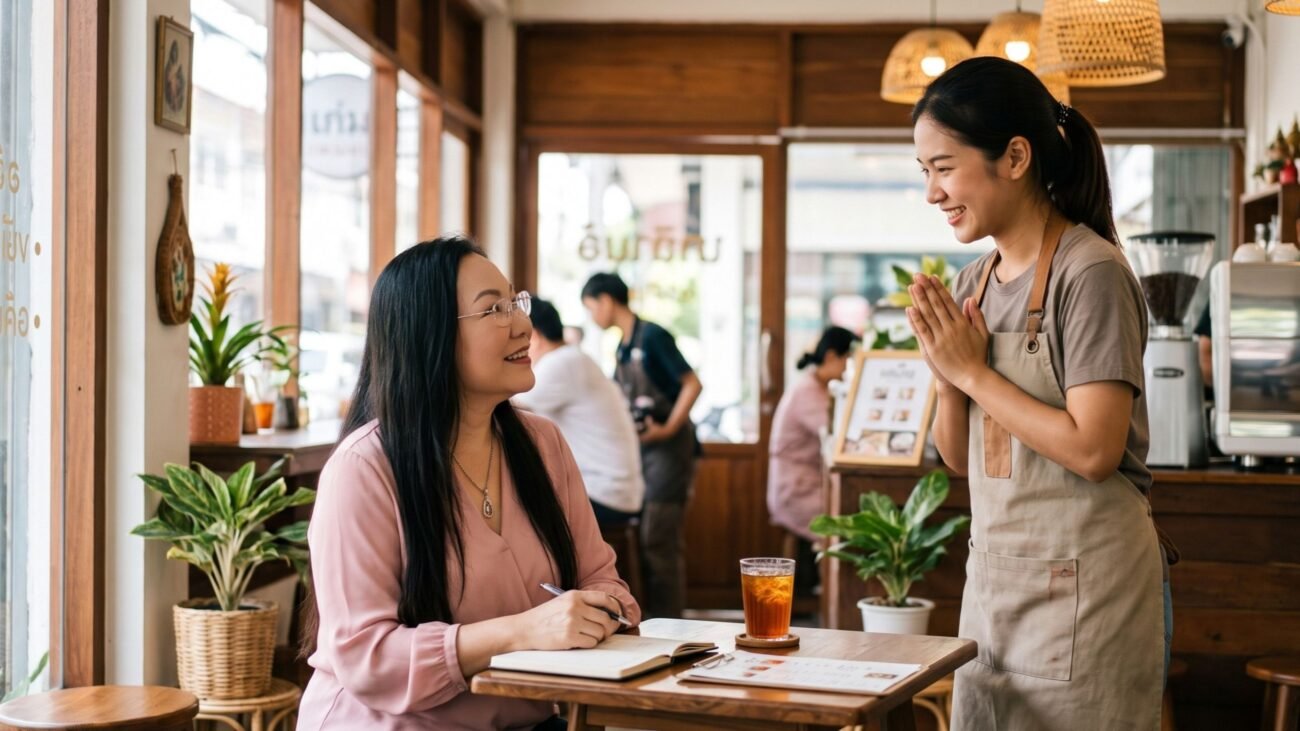
A little challenge for you: Imagine you’ve just arrived in Thailand. You walk into a cozy, local café to escape the afternoon heat. Can you picture it?
- How would you politely greet the person serving you?
- What phrase do you use to express your gratitude when they hand you your drink?
- How do you say a warm goodbye as you head back out into the sunshine?
Remember, fluency doesn’t happen overnight, but confidence grows through practice — one word and one small conversation at a time. You already have enough Thai in your toolkit to get started, so keep practising. Your Thai journey has officially begun!
To keep your momentum going, make sure to visit the blog every day to check out my free Daily Thai Confidence mini-lessons to keep building your vocabulary. Or, if you’re ready for personalised guidance, reach out to book your first private one-to-one tuition session.
แล้วพบกัน (láew phób gān) in the next post!
