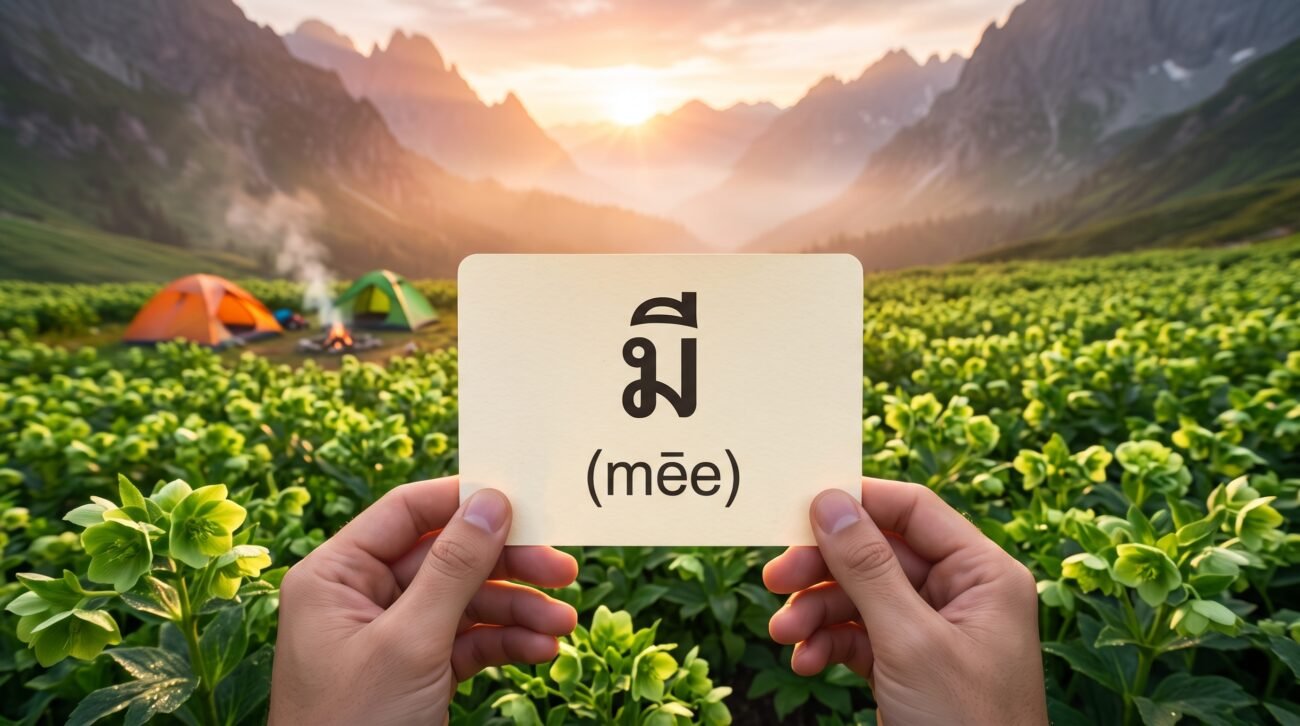
Thai Verb: มี (mēe)
Meaning: to have (possession)
The Thai verb มี (mēe) means “to have”. It is used to express possession or ownership of something, or to indicate that someone has something available to them. It is commonly used with nouns referring to objects, people, money, time, resources, and abstract concepts such as knowledge, experience, and confidence.
The typical structure usually follow the pattern: subject + มี (mēe) + noun.
For example (ตัวอย่างเช่น – dtūa-awyàang chên)
เธอมีประสบการณ์ทำงานในประเทศไทย
thēr mēe bprà-sòb-gāan thām-ngāan nāi bprà-thâed Thāi
Literal: She has experience do-work in country Thai.
She has experience working in Thailand.
เรามีเป้าหมายเดียวกัน
rāo mēe bpâo-hmǎai dīew-gān
Literal: We have goal single one-each other.
We have the same goal.
คุณมีความคิดที่ดี
khūn mēe khwāam-khíd thêe dēe
Literal: You have idea that good.
You have a good idea.
เรามีโอกาสเรียนรู้สิ่งใหม่ ๆ
rāo mēe ō-gàad rīan-rúu sìng hmài-hmài
Literal: We have opportunity learn-know thing new-new.
We have the opportunity to learn new things.
To form negative sentences, the negative adverb ไม่ (mâi), meaning “not”, is placed before the verb มี (mēe) – subject + ไม่ (mâi) + มี (mēe) + noun.
For example (ตัวอย่างเช่น – dtūa-awyàang chên)
ฉันไม่มีรถ
chǎn mâi mēe ród
Literal: I not have car.
I have a car.
เขาไม่มีเงิน
khǎo mâi mēe ngēuhn
Literal: He not have money.
He doesn’t have any money.
เราไม่มีเวลาวันนี้
rāo mâi mēe wāy-lāa wān-née
Literal: We not have time day-this.
We don’t have time today.
เราไม่มีแผนสำหรับวันหยุดสุดสัปดาห์นี้
rāo mâi mēe phǎen sǎm-hràb wān-hyùd sùd-sàb-dāa née
Literal: We not have plan for day-stop end-week this.
We don’t have any plans for this weekend.
To form yes/no questions, the question particle ไหม (hmǎi? = or not?) is placed at the end of the sentence. This turns a statement into a question – subject + มี (mēe) + noun + ไหม (hmǎi? = or not?).
For example (ตัวอย่างเช่น – dtūa-awyàang chên)
คุณมีเวลาว่างไหม
khūn mēe wāy-lāa wâang hmǎi?
Literal: You have time available or not?
Do you have free time?
คุณมีพี่น้องไหม
khūn mēe phêe-náwng hmǎi?
Literal: You have sibling or not?
Do you have any siblings?
คุณมีเรียนภาษาไทยวันนี้ไหม
khūn mēe rīan phāa-sǎa Thāi wān-née hmǎi?
Literal: You have learn language Thai day-this or not?
Do you have a Thai language lesson today?
คุณมีแผนสำหรับวันหยุดสุดสัปดาห์นี้ไหม
khūn mēe phǎen sǎm-hràb wān-hyùd sùd-sàb-dāa née hmǎi?
Literal: We not have plan for day-stop end-week this or not?
Do you have any plans for this weekend?
The verb มี (mēe) can also be used to express the existence or presence of someone or something. In this usage, it is equivalent to “there is” or “there are” in English. Unlike its use to express possession, where the sentence tells us that someone has something, this usage simply tells us that something or someone exists or is present. It does not necessarily indicate ownership.
The typical structure usually follow the pattern: มี (mēe) + noun (+ location).
มีร้านอาหารอยู่ใกล้ตลาด
mēe ráan-āa-hǎan awyùu glâi dtà-hlàad
Literal: Have shop-food to be situated near market.
There is a restaurant near the market.
มีโรงเรียนอยู่ตรงนั้น
mēe rōng-rīan awyùu dtrōng nán
Literal: Have school to be situated straight there.
There is a school right there.
มีหลายวิธีในการเรียนภาษาไทย
mēe hlǎai wí-thēe nāi gāan-rīan phāa-sǎa Thāi
Literal: Have many method in the process of learning language Thai.
There are many ways to learn Thai language.
มีโรงแรมหลายแห่งในเมืองนี้
mēe rōng-rāem hlǎai hàeng nāi mēuang née
Literal: Have hotel many location in city this.
There are several hotels in this town.
Grammar Help: The noun เมือง (mēuang) can mean either “city” or “town”, depending on the context. Thai does not have two separate everyday words that correspond exactly to the English words “city” and “town”. Instead, เมือง (mēuang) is used for both, and its intended meaning is usually understood from the context or the place being discussed.
Practice Exercise (แบบฝึกหัด – bàeb fèuk-hàd)
Practise putting your newly learned Thai word into a sentence by translating the following sentences below.
- They have two children.
- Do you have any questions?
- I don’t have an opinion about this matter.
- We don’t have any other choice.
- I have no experience with this.
- There is someone outside.
- I have the opportunity to study with this teacher.
- There are ten students in the room.
- Do you have enough money?
- He doesn’t have confidence in himself.
