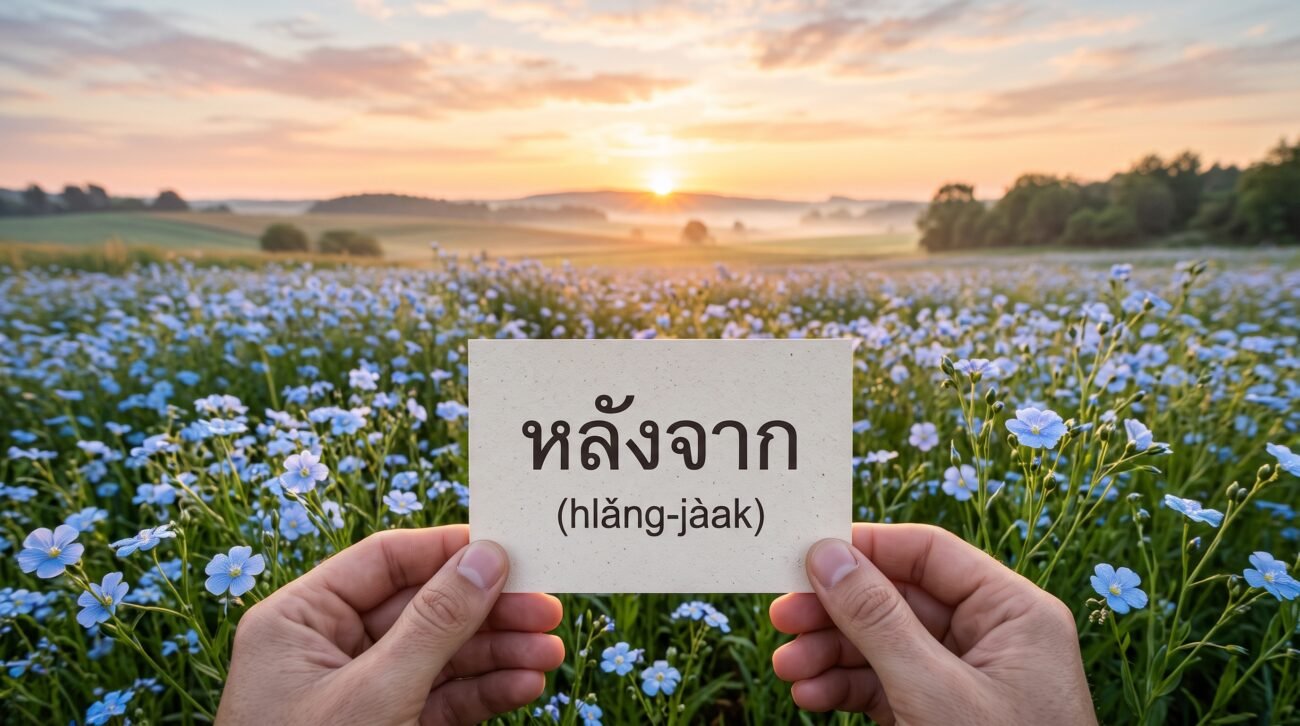
Thai Conjunction: หลังจาก (hlǎng-jàak)
Meaning: after / afterwards
The Thai subordinating conjunction of time หลังจาก (hlǎng-jàak), meaning “after” or “afterwards”. It is used to connect two events and indicates that the action in the main clause happens after the event described in the subordinate clause.
The subordinate clause usually comes first, followed by the main clause: หลังจาก (hlǎng-jàak) + subordinate clause + main clause.
For example (ตัวอย่างเช่น – dtūa-awyàang chên)
หลังจากกินอาหารเย็น พวกเราดูหนังด้วยกัน
hlǎng-jàak gīn āa-hǎan-yēn, phûak-rāo dūu hnǎng dûay-gān
Literal: After-from eat food-evening, we watch move with-each other.
After having dinner, we watched a movie together.
หลังจากเลิกงาน ฉันจะไปซื้อของที่ตลาด
hlǎng-jàak lêuhk-ngāan, chǎn jà bpāi séu-khǎwng thêe dtà-hlàad
Literal: After-from finish-work, I will go buy-things at market.
After work, I will go shopping at the market.
หลังจากเขากลับถึงบ้าน เขาก็ไปอาบน้ำเลย
hlǎng-jàak khǎo glàb thěung bâan, khǎo gâw bpāi àab-nám lēuy
Literal: After-from he return arrive home, he then go take a shower right away.
After he got home, he went straight to take a shower.
หลังจากเรียนภาษาไทยเป็นเวลาสองชั่วโมง ผมรู้สึกเหนื่อยมาก
hlǎng-jàak rīan phāa-sǎa Thāi bpēn wāy-lāa sǎwng chûa-mōng, phǒm rúu-sèuk hnèuay mâak
Literal: After learning language Thai to be time two hour, I feel tired very.
After learning Thai for two hours, I feel very tired.
However, the sentence order can also reversed, with the main clause coming first and the subordinate clause following: main clause + หลังจาก (hlǎng-jàak) + subordinate clause.
For example (ตัวอย่างเช่น – dtūa-awyàang chên)
พวกเราไปเดินเล่นที่สวนสาธารณะหลังจากกินข้าวเสร็จ
phûak-rāo bpāi dēuhn-lên thêe sǔan sǎa-thāa-rá-ná hlǎng-jàak gīn-khâo sèd
Literal: We go walk-play at garden public after-from eat-rice finished.
We went for a walk in the park after we finished eating.
ฉันต้องปรับตัวกับหลายสิ่งหลายอย่างหลังจากย้ายมาอาศัยอยู่ที่ประเทศอังกฤษ
chǎn dtâwng bpràb-dtūa gàb hlǎai-sìng-hlǎai-awyàang hlǎng-jàak yáai māa āa-sǎi awyùu thêe bprà-thâed āng-grìd
Literal: I have to adjust-oneself with many-thing-many-type after-from move have done live to be situated in country England.
I had to adjust to many things after moving to live in England.
เขาโทรหาฉันหลังจากเขากลับถึงบ้าน
khǎo thōo-hǎa chǎn hlǎng-jàak khǎo glàb thěung bâan
Literal: He phone-search for me after-from he return arrive home.
He called me after he got home.
เธอประสบความสำเร็จหลังจากทำงานหนักมาหลายเดือน
thēr bprà-sòb khwāam-sǎm-hrèd hlǎng-jàak thām-ngāan hnàk māa hlǎai dēuan
Literal: She experience success after-from do-work heavy have done many month.
She achieved success after many months of hard work.
Grammar Help: When มา (māa) is placed after a verb or verb phrase, it indicates that an action has been completed – subject + main verb / verb phrase + มา (māa). It is similar to saying, “have been…” or “have done…”, referring to an action or activity that has already been completed. To learn more about how to use the word มา (māa), visit the previous post ➜ Daily Thai Confidence: Using มา (māa).
You may also hear Thai speakers adding ที่ (thêe) after the conjunction หลังจาก (hlǎng-jàak), forming หลังจากที่ (hlǎng-jàak thêe) + subordinate clause. Both forms mean “after” and are used to introduce a subordinate time clause. The word ที่ (thêe) helps connect หลังจาก (hlǎng-jàak) to the clause that follows it more explicitly. However, it is not essential, and Thai speakers often omit it in everyday conversation.
For example (ตัวอย่างเช่น – dtūa-awyàang chên)
หลังจากที่ฉันกินข้าวเสร็จ ฉันก็ไปทำงาน
hlǎng-jàak thêe chǎn gīn-khâo sèd, chǎn gâw bpāi thām-ngāan
Literal: After-from which I eat-rice finished, I then go do-work.
After I finished eating, I went to work.
หลังจากที่ฉันเรียนจบ ฉันก็เริ่มหางาน
hlǎng-jàak thêe chǎn rīan-jòb, chǎn gâw rêuhm hǎa ngāan
Literal: After-from which I learn-ended, I then start search for job.
After I graduated, I started looking for a job.
พวกเขาย้ายไปเชียงใหม่หลังจากที่พวกเขาแต่งงานกัน
phûak-khǎo yáai bpāi Chīang Mài hlǎng-jàak thêe phûak-khǎo dtàeng-ngāan gān
Literal: They move to Chiang Mai after-from which they marry each other.
They moved to Chiang Mai after they got married.
ฉันเข้าใจสถานการณ์มากขึ้นหลังจากที่เขาอธิบายทุกอย่าง
chǎn khâo-jāi sà-thǎa-ná-gāan mâak-khêun hlǎng-jàak thêe khǎo à-thí-bāai thúk-awyàang
Literal: I understand situation much-up after-from which he explain every-type.
I understood the situation better after he explained everything.
You may also hear Thai speakers adding นั้น (nán) after หลังจาก (hlǎng-jàak), forming หลังจากนั้น (hlǎng-jàak nán), which means “after that” or “afterwards”. The word นั้น (nán) means “that” and refers back to an event, action or situation that has already been mentioned or is understood from the context.
Unlike หลังจาก (hlǎng-jàak), which is commonly used to introduce a subordinate time clause, หลังจากนั้น (hlǎng-jàak nán) refers to a previously mentioned event and indicates what happens next – หลังจากนั้น (hlǎng-jàak nán) + main clause.
For example (ตัวอย่างเช่น – dtūa-awyàang chên)
ฉันตื่นนอนตอนเจ็ดโมง หลังจากนั้นฉันก็อาบน้ำ
chǎn dtèun-nāwn dtāwn jèd mōng cháo, hlǎng-jàak nán chǎn gâw àab-nám
Literal: I wake-sleep at seven o’clock morning, after that I then take a shower.
I woke up at seven o’clock in the morning; after that I took a shower.
เราไปกินข้าวด้วยกัน หลังจากนั้นเราก็ไปดูหนัง
rāo bpāi gīn-khâow dûay-gān, hlǎng-jàak nán rāo gâw bpāi dūu hnǎng
Literal: We go eat-rice with-each other, after that we then go watch movie.
We went out for a meal together; afterwards, we went to see a film.
ฉันย้ายมาอยู่ที่ประเทศอังกฤษห้าปีที่แล้ว หลังจากนั้นชีวิตของฉันก็เปลี่ยนไปมาก
chǎn yáai māa awyùu thêe bprà-thâed āng-grìd hǎa bpēe thêe-láew, hlǎng-jàak nán chēe-wíd khǎwng-chǎn gâw bplìan-bpāi mâak
Literal: I move have done to be situated in country England five year ago, after that life belonging to me then change-go much.
I moved to England five years ago; after that my life has changed a great deal.
เราประชุมกันตอนเช้า หลังจากนั้นทุกคนก็แยกย้ายกันไปทำงาน
rāo bprà-chūm gān dtāwn cháo, hlǎng-jàak nán thúk-khōn gâw yâek-yáai gān bpāi thām-ngāan
Literal: We have meeting with each other in morning, after that every-person separate-move from each other go do-work.
We had a meeting in the morning; after that, everyone went their separate ways to work.
Practice Exercise (แบบฝึกหัด – bàeb fèuk-hàd)
Practise putting your newly learned Thai word into a sentence by translating the following sentences below.
- After I finish exercising, I will take a shower.
- After he changed jobs, his life improved a lot.
- After we talked, I understood his reasons better.
- After the children have gone to bed, the parents have some time to relax.
- After working hard for many years, she finally became successful.
- After the rain stopped, we went for a walk in the park.
- After she received the good news, she immediately called her family to tell them.
- After moving house to live here, I got to know my neighbours better.
- After he made a mistake, he tried to find a way to solve the problem.
- After travelling all day, everyone wanted to rest.
