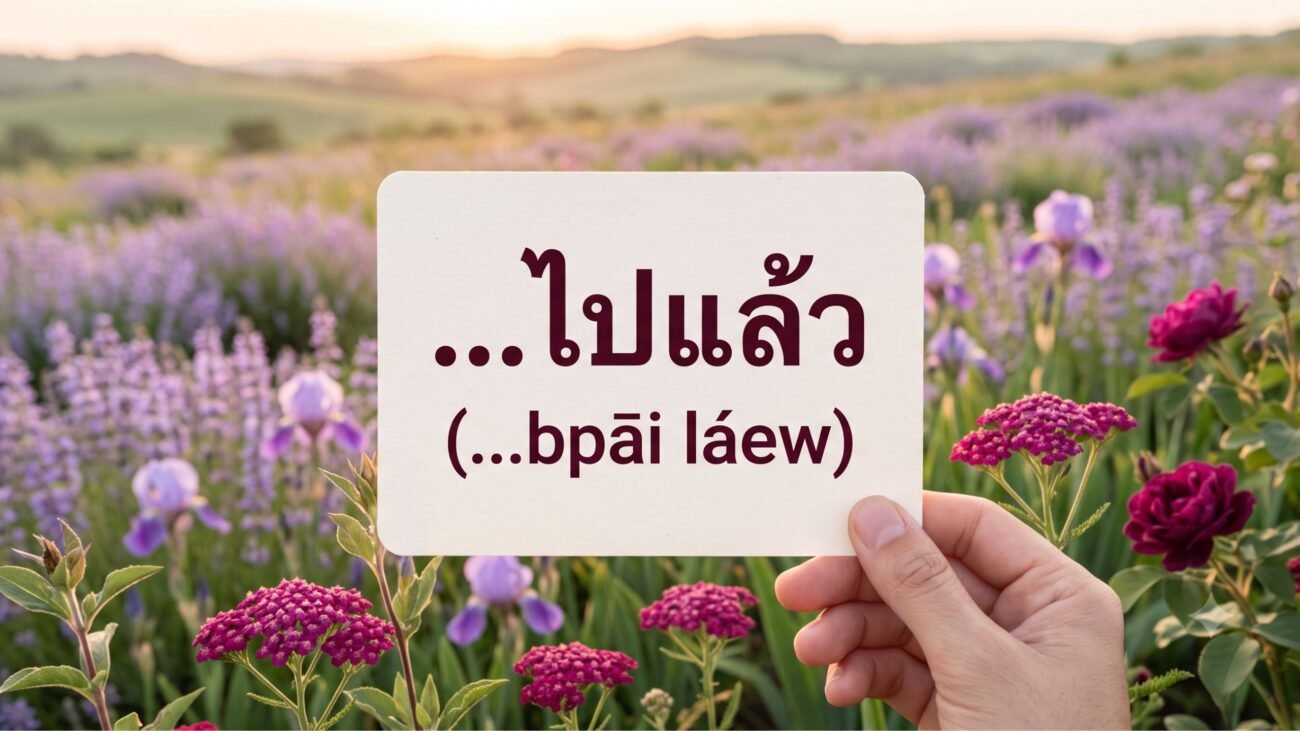
Grammatic Pattern: …ไปแล้ว (…bpāi láew)
Meaning: have already… / already did…
In this Thai lesson, we learn how to use the common Thai pattern …ไปแล้ว (…bpāi láew), which is often translated as ‘have already…’ or ‘already did…’ Although ไป (bpāi) normally means ‘to go,’ it does not have its literal meaning in this pattern. Instead, it functions as a directional complement (also called a completive complement) that follows another verb. Together, with แล้ว (láew = already), it shows that an action has been fully completed and that its result or effect now exists.
The typical structure usually follows the pattern: verb + ไปแล้ว (bpāi láew)
For examples (ตัวอย่างเช่น — dtūa-awyàang chên)
ฉันบอกเขาไปแล้ว
chǎn bàwk khǎo bpāi láew
Literal: I tell him already have.
I have already told him.
เขาขายรถไปแล้ว
khǎo khǎai ród bpāi láew
Literal: He sell car already have.
He has already sold the car.
ฉันส่งอีเมลไปแล้ว
chǎn sòng email bpāi láew
Literal: I send email already have.
I have already sent the email.
ทุกอย่างเปลี่ยนไปแล้ว
thúk-awyàang bplìan bpāi láew
Literal: Everything change already have.
Everything has changed.
Homework (การบ้าน — gāan-bâan)
Practise putting your newly learned Thai word into a sentence by translating the following sentences below.
- He has already left the house.
- I have already forgotten about that.
- I have already paid.
- I have already sent the message.
- I have already asked him.
