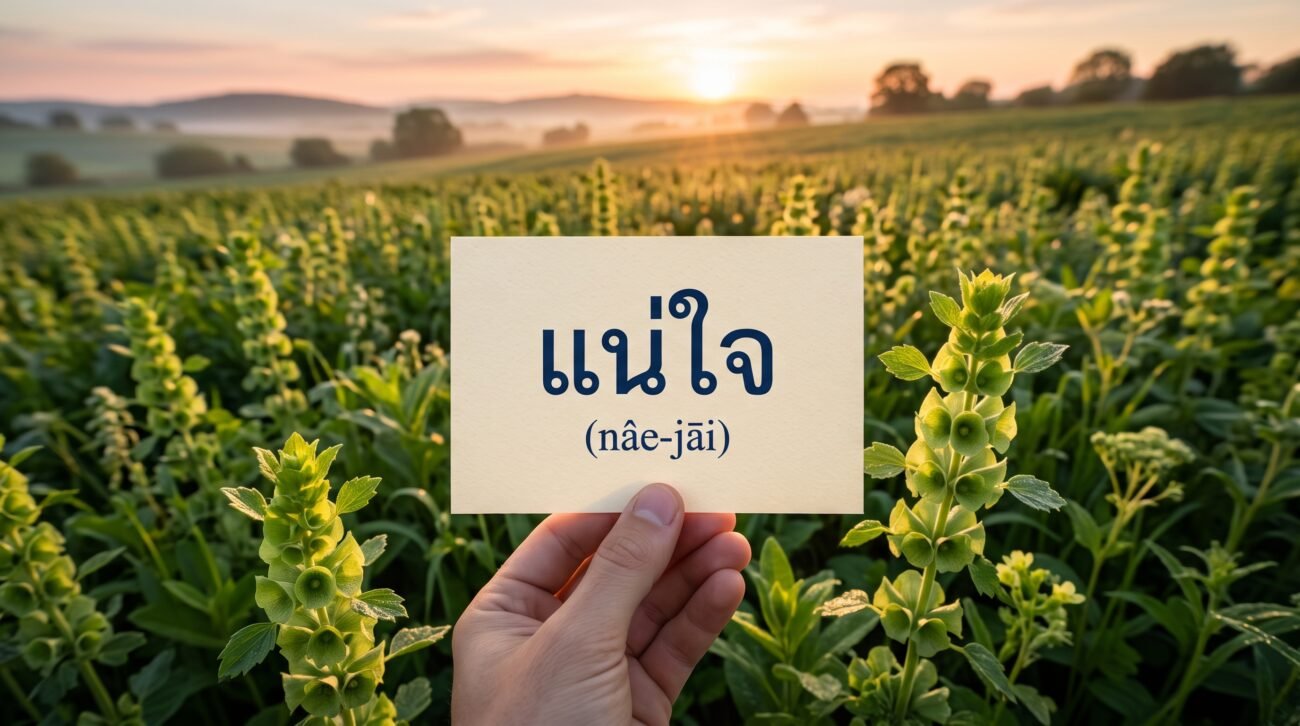
Thai Verb: แน่ใจ (nâe-jāi)
Meaning: to be sure / to be certain / to be confident (about something)
The Thai word แน่ใจ (nâe-jāi) means “to be confident,’ “to be certain,” or “to be sure” about something. It is used when talking about how certain someone is about something, whether it is a fact, information, a decision, or something they believe will happen. It is particularly useful when asking someone to confirm information, checking whether they are certain about something, or expressing confidence in what you know or believe.
Although แน่ใจ (nâe-jāi) and มั่นใจ (mân-jāi) can both translate as “to be sure” or “to be confident”, there is a difference in emphasis:
- แน่ใจ (nâe-jāi) focuses more on certainty – whether you are sure that something is true, correct, or will happen.
- มั่นใจ (mân-jāi) – focuses more on confidence – feeling confident in your knowledge, ability, judgement, or decision. Check out this post to learn more ➜ Daily Thai Confidence: Using มั่นใจ (mân-jāi).
For example (ตัวอย่างเช่น – dtūa-awyàang chên)
ผมแน่ใจ
phǒm nâe-jāi
Literal: I sure.
I am sure.
ฉันไม่แน่ใจ
chǎn mâi nâe-jāi
Literal: I not sure.
I’m not sure.
ผมยังไม่แน่ใจ
phǒm yāng mâi nâe-jāi
Literal: I still not sure.
I’m not sure yet.
ผมค่อนข้างแน่ใจ
phǒm khâwn-khâang nâe-jāi
Literal: I quite sure.
I am quite sure.
The verb แน่ใจ (nâe-jāi) is often followed by the conjunction ว่า (wâa), which introduces a complement clause explaining what someone is sure about. It works similarly to the conjunction “that” in English, linking the expression of certainty with the information that follows – subject + แน่ใจ (nâe-jāi) + ว่า (wâa) + complement clause (the explanation the subject is sure about).
For example (ตัวอย่างเช่น – dtūa-awyàang chên)
ผมแน่ใจว่าเขาพูดความจริง
phǒm nâe-jāi wâa khǎo phûud khwāam-jīng
Literal: I sure that he speak truth.
I am sure that he is telling the truth.
ผมแน่ใจว่าเขาจะมา
phǒm nâe-jāi wâa khǎo jà māa
Literal: I sure that he will come.
I am sure that he will come.
ฉันแน่ใจว่าเรามาถูกทางแล้ว
chǎn nâe-jāi wâa rāo māa thùuk thāang láew
Literal: I sure that we come correct way already.
I am sure that we are on the right track.
ผมไม่แน่ใจว่าเธอเข้าใจหรือเปล่า
phǒm mâi nâe-jāi wâa thēr khâo-jāi hrěu-bplào?
Literal: I not sure that she understand or not.
I’m not sure if she understands.
Grammar Help: When expressing uncertainty, ไม่แน่ใจว่า (mâi nâe-jāi wâa…) can often be translated as “not sure whether…” or “not sure if…” in English.
Practice Exercise (แบบฝึกหัด – bàeb fèuk-hàd)
Practise putting your newly learned Thai word into a sentence by translating the following sentences below.
- I am quite sure that he already knows about this.
- I am still not sure whether I should buy this house.
- If you are not sure, you can try asking him again.
- I want to make sure everything is ready before setting off.
- You can be sure that I will help you.
- I am sure he didn’t mean to upset you.
- She is not sure whether this decision is right.
- I want to make sure that we understand each other before starting work.
- Are you sure you haven’t got the appointment date wrong?
- I am sure that if you practise more, you will become better at speaking Thai.
